


In the dynamic technological landscape of 2026, the LED industry has become the heart of the digital experience. We are witnessing an unprecedented evolution and rapid growth, where these displays not only decorate spaces but also redefine human interaction. Nowadays, industries like entertainment, retail, and the corporate sector are searching for display solutions that capture attention in a world overflowing with stimuli.
Current demand calls for excellence, so leading manufacturers have shifted their focus: it’s no longer just about achieving maximum brightness or 8K resolution; they must also guarantee long-term durability and adaptability. In 2026, the priority is to offer technologies like MicroLED and modular LED wall systems that ensure a profitable and sustainable investment amidst market changes.
An LED wall is much more than just a collection of panels. It’s a strategic transformation tool that enables businesses to communicate with astonishing clarity, turning every message into an immersive experience that emotionally connects with the audience. Whether you’re looking to elevate your brand, enhance office collaboration, or create an unforgettable visual impact, it’s time to explore the new digital signage solutions.
The LED Screens Industry in 2026: A Glimpse into the Future
2026 marks a turning point where science fiction meets business reality. Screens have evolved into smart infrastructures that shape the aesthetics of modern cities. With the market valued at over $36 billion this year, the LED industry is expanding both in size and purpose: to create unbreakable visual bridges between brands and their audiences.
The Evolution of LED Walls
The trajectory of LED solutions is a story of continuous technological advancement. Gone are the days of bulky panels with visible seams. Today, the industry has perfected Direct View LED technology, achieving completely seamless surfaces.
The most critical development has been the significant reduction in pixel pitch (the distance between pixels). What was once considered a luxury, such as a pixel pitch of 1.2 mm or less, is now the standard, allowing the human eye to perceive sharp images even at close range.
This evolution meets the growing demand for solutions that not only display content but also create immersive experiences across industries, from education to high-level military command.
The Push for Durability and Long-Lasting Performance
In today’s market, performance alone isn’t enough; durability is key. Leading manufacturers are now prioritizing durability as their main selling point. It’s no longer sufficient for a screen to simply shine; it must also endure.
To this end, the use of IP65 ratings has become standard for outdoor LED video walls, ensuring complete protection against dust and pressurized water jets. Technologies like COB (Chip on Board) and GOB (Glue on Board) are being adopted to protect delicate diodes from physical impacts, humidity, and static electricity.
By extending the lifespan of equipment in high-traffic commercial environments, companies ensure a stronger return on investment (ROI), significantly reducing maintenance and replacement costs.
Cutting-Edge Control Systems and Processors
If the panels are the body, the control system is the brain. In 2026, managing an LED screen will be more intuitive and powerful than ever, thanks to companies like NovaStar.
The new processors and control boards not only handle resolution; they also integrate artificial intelligence for automatic pixel mapping and real-time color calibration.
Systems like the NovaStar MX40 Pro series enable the handling of 8K content with HDR10, eliminating latency or flicker; critical for live event streaming and virtual production.
These controllers ensure that, regardless of the complexity of the installation, visual quality remains impeccable, stable, and easy to manage remotely via the cloud.


Speak With a Dedicated Project Manager Who Will Oversee Your LED Setup.
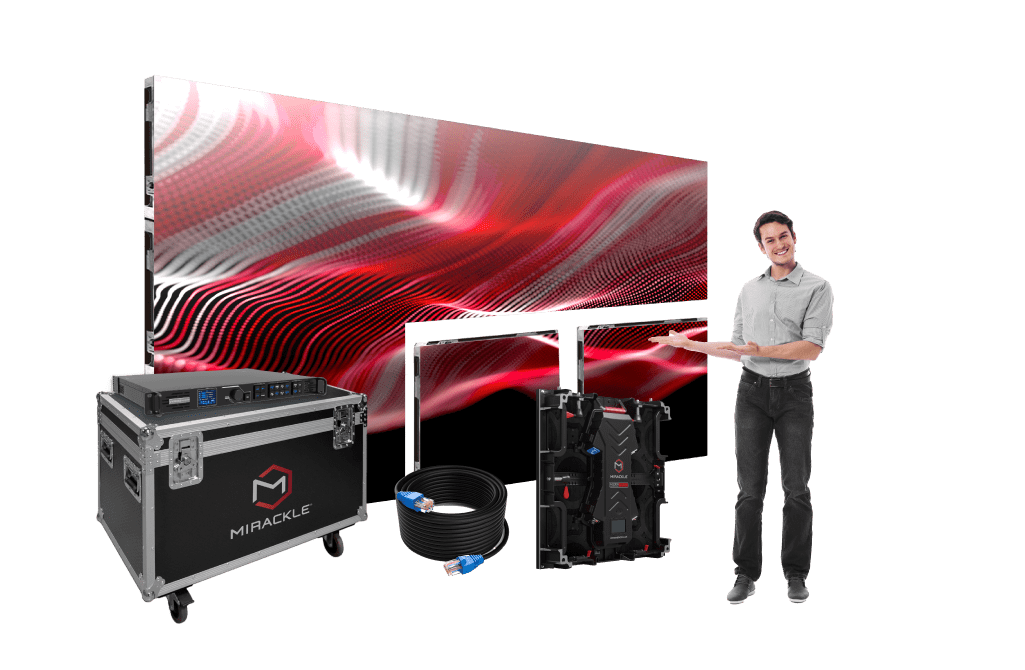
The Impact of Technological Innovations on LED Display Panels
Innovation in LED devices is a functional revolution, and this year, advances in microprocessors and semiconductor materials have allowed displays to surpass past limitations, offering visual fidelity once thought impossible. Let’s take a look at three innovations that have become the gold standard in the industry.
High Refresh Rates and Their Benefits
In today’s entertainment landscape, refresh rate is what separates enthusiasts from professionals. While standard displays operate at 1920Hz, leading manufacturers are prioritizing refresh rates of 3840Hz and even 7680Hz by 2026.
High refresh rates eliminate annoying scan lines and flicker when recording with high-speed cameras. This is essential for LED displays in virtual productions and film studios. They also ensure smoothness in fast-moving scenes, removing blur and guaranteeing crystal-clear sharpness in sports broadcasts.
Moreover, they significantly reduce eye strain in environments where people spend extended periods in front of the screen, such as command centers or corporate conventions.
Synchronous vs. Asynchronous Systems: What’s Best for Your Needs?
Content management on an LED display depends on the “brain” or control system you choose. Understanding the distinction between synchronous and asynchronous systems is now more important than ever.
Synchronous Systems
operate in real-time, mirroring an external input source; typically a computer or video processor. The control monitor instantly reflects what's shown on the panel. This configuration is preferred for television studios and sports stadiums, where zero latency and immediate transmission of live data or camera feeds are non-negotiable.
Asynchronous Systems
in contrast, operate independently. Content is sent to the controller via Wi-Fi, 4G/5G, or USB, stored in its internal memory, and played back autonomously. This is ideal for the retail sector, billboards, and corporate signage, as it doesn’t require a permanently connected PC, reducing costs and simplifying management across multiple locations.
The Growing Need for Flexibility
Installation versatility is what allows companies to integrate LED technology into any architectural environment. Flexibility today manifests in two key areas:
Adaptable installation methods:
Wall mounting is ideal for boardrooms and retail spaces where space is limited; floor mounting is perfect for temporary events or stages; suspended mounting creates a massive visual impact in shopping malls and trade shows.
Front maintenance and magnetic modules:
The true revolution for the end-user is Full Front Service. Thanks to magnetic modules, any panel can be removed from the front in seconds using a suction tool. This eliminates the need for service areas behind the screen.
Why Partner with the Right Manufacturer in 2026?
In a market saturated with options, the difference between a screen that simply “works” and one that drives your business growth lies in the choice of manufacturer. By 2026, LED technology will represent a significant capital investment, making partnerships with experts essential to ensure operational continuity.
A Five-Year Warranty: Peace of Mind for the Long Term
What was once the exception is now the hallmark of top-tier manufacturers. A five-year warranty has become the gold standard, serving as both a promise of quality and insurance for your investment.
This extended coverage protects against technical defects and ensures businesses have reliable technical support and access to genuine replacement parts for half a decade. By eliminating uncertainty around long-term repair costs, business owners can focus on what truly matters: captivating their audience.
Maximizing ROI through Advanced Technologies
Investing in cutting-edge LED solutions is a strategy to maximize profit. The return on investment (ROI) manifests through:
- Energy and weight efficiency: Next-generation lightweight designs dramatically reduce transportation and installation costs, while high-efficiency LEDs lower monthly electricity consumption.
- Technological integration: The ability to integrate with data analytics, AI, and interactive sensors allows for real-time advertising personalization, increasing conversion rates in the retail sector.
- Reduced downtime: Thanks to the robustness of modern components, display interruptions are virtually nonexistent, ensuring your message is always active and generating revenue.
Why Mirackle Is Your Ideal Partner for LED Video Walls in 2026
At the forefront of innovation is Mirackle, solidifying its position as the undisputed leader in the sector. Choosing Mirackle means accessing refined technical expertise and the most advanced technologies available today.
What makes Mirackle different?
For one, we implement modular designs that allow for creative configurations. You have unlimited possibilities to adapt to any architectural vision. Our solutions are also designed to work seamlessly with state-of-the-art control systems and cloud-based management platforms.
Beyond the sale, Mirackle offers comprehensive support (from the design phase to after-sales maintenance) ensuring your LED devices perform like new.


Virtual production is no longer defined by budget size, but by vision…And the tools chosen to bring that vision to life.